Thursday, December 6, 2012

The Khasi Hills Unitarian Child Orphanage

Unitarian boy peering through the window.


After four days straight of traveling and sleeping on the floors of various train and bus terminals I finally arrived in the Khasi Hills of India's NE state, Meghalaya. Known as the Scottish highlands of Asia the Khasi Hills are just that; rolling hills of dried grass and barren rock, whipping wind and a thick fog.

Two years ago during my time as a camp counselor for Unitarian Universalist youth, a friend of mine mentioned a small Unitarian congregation somewhere in India. Unitarian Universalism is a liberal, all inclusive, non-denominational faith that teaches the morals of all faiths (without the dogma) while pushing for social change such as immigration and LGBTQ rights, and Unitarianism is it’s grandfather religion not commonly seen today. During one of my most recent projects in Varanasi I remembered this conversation and began looking around for contacts with hopes of finding the location of this community. One week later, through a series of emails from multiple contacts, I was introduced to a delightful man named Nangroi, who invited me to stay in his village and with the local Unitarian congregation of over 10,000 individuals.
Three 'brothers' eating lunch together.


Visiting each beautifully modest church house of the village allowed for discussion of hardships with the local, predominantly farmer population. With Nangroi and his wonderful family helping as translators I was informed about the rural difficulties of crop prices, medical aid and literacy.

Potatoes, the regional cash crop grown, yield a meager value when brought to market. The flooding of this mono-crop in the market place makes it very hard for families to raise their income and better their standard of living. Due to the rural location of the Unitarians in the Khasi Hills, medical aid rarely makes its way to the villages, forcing people to travel several hours to a hospital in the nearest city. With most families numbering from 5-10 people per household, it becomes a struggle to support everyone with their usual salary, which is equivalent to $400-$500(USD) per month.
Boy trying to find space away from the other children.


At the edge of Kharang village I was shown the Unitarian Child Orphanage for the Khasi Hills. Approaching the door I was introduced to each child with a bashful handshake and a lively, English, “How do you do?” The Unitarian Child Orphanage, currently housing 20 children (10 boys and 10 girls) ranging from ages 6-15 rests on a several acre plot with forested hills, jungle paths, small creeks and little pools. With a simple terrace garden, worm compost bin and their own personal water pump, Nangroi and other members of the UUNEI (Unitarian Union of North East India) hope to eventually raise enough money to build a health care center, school, community fishery and edible jungle garden to help with fresh fruit and medicinal herbs.
Dinner time in the kitchen.

Usually each child travels to the nearest school house each weekday but as I was lucky enough to visit during a winter break we were able to spend our time climbing through the forest, playing tag or getting in some quality fun on the swing and slide in the playground. Around meal time the older of the children who have been delegated more responsibility would join the two 'mothers’ of the house, helping prepare the main meal of rice and potatoes. After clean up play-time continued into the night and when the electricity would cut out the darkness would be filled with giggles and flickering candle light as play-time would scurry through the dark. After reading English books by candle, group songs and rhymes were sung before the nightly Earth, Wind & Fire dance party.
Learning to read English by candle light.
After such a long time on the road documenting poverty and child desperation it was such a wonderful time getting to know these brilliant youth. Even though each of them has lost at least one parent and still deal with emotional swings from pain it is a beautiful thing to see each of them come together to support one another and create an even larger family.

To the children at the Khasi Hills Unitarian Child Orphanage, thanks for making me a friend and teaching me to play Cricket; I promise I’ll do better next time.

Woman watching a storm fall outside the kitchen window.

Saturday, April 7, 2012

Still Wandering Uttar Pradesh

I'm continuing with my work around the rural communities in the state of Uttar Pradesh, India. As mentioned in my previous post I'm trying to observe and document the myriad of societal struggles facing these isolated villages without holding a targeted agenda. As I witness the many issues that have presented themselves to me I decided to use this weeks article to shed a little light on the overbearing hardships of starvation, medical illnesses, unemployment and poverty.


Man napping through the day due to unemployment - Mahoba.

A hungry woman pleading for help - Balidi Kala village.

A little girl caring for her dying sister - Balidi Kala village.

Child waiting in a field - Swati Bruara village.

Girl playing outside her home - Itwanduendaila village.

Tuesday, March 27, 2012

Wandering Uttar Pradesh

I'm often asked how I decide where to travel and which stories to cover. My response usually refers back to a conversation I had with another humanitarian photojournalist Zoriah Miller. We discussed that it is sometimes essential to enter a region without seeking a specific story or having a targeted agenda. We both agree that if a photographer or journalist has their focus fixed on a specific story than such a narrow view can marginalize or obscure an equally important social justice issues being played out right in front of them.

Most recently, this question of how I go about my work was posed to me by a reporter for the Hindustan Times. It was then that I checked in with myself only to realized that for the past four months I had been traveling in search of a specific story. Realizing this, I decided to cancel the story that I was traveling toward and got off at the next train stop. The following week was spent wandering among rural villages in the northern state of Uttar Pradesh. Not knowing what I would find, I decided to observe the societal struggles caused by hunger, poverty, and a lack of education and clean drinking water which effects everyday life in these secluded regions.


Man struggling against hunger - Ramtikawa village.

A man worried about low crop prices - Nadin Kurmiyan village.

Mother holding her child - Ramtikawa village.

A family gathered outside of their home - Soti Kaprawa village.

Tuesday, February 28, 2012

Varanasi

The city of Varanasi in the northern state of Uttar Pradesh is considered by Hindus a holy place because of its connection with the sacred Ganges river. Even with the extremely dense urbanization of the city, religious icons and shrines still dot almost every other street corner and alleyway. Commuting along the ghats beside the river bank, I decided to dedicate an article to the temple keepers, holy men, and ceremonial performers. For it is these lay Hindu men who provide spiritually vital functions for their Hindu community as they lead public prayers, family pujas, and provide the blessings for the dead waiting to be cremated by the holy river.

Man performing a nightly puja.
A group of holy men reciting mantras.
A crowd begging for food blessings.
A Baba blessing people along the river bank.
Nightly fire ceremony along the Ganges river.
Temple keeper painting a shrine dedicated to Shiva.

Sunday, February 12, 2012

Sadhus

Sadhus can often be seen as Hindu ascetics found throughout India. These men and woman who follow the holy Hindu scriptures, sometimes aligned with a specific god, abandon a life of material possessions and creature comforts with the goal of obtaining nirvana through suffering.

I believe the Muslim Sufi poet Latif describes them best when saying, “Yogis are many, but I love these wandering Sadhus. Smeared with dust, they eat little, never saving a grain of rice in their begging bowls. No food in their packs, they carry only hunger. No desire to eat have they. Thirst they pour and drink. These ascetics have conquered their desires. In their wilderness they found the destination from which they searched so long.”

Sadhu outside of a rural village shrine - Uttar Pradesh.
Sadhu in prayer - Varanasi.
Sadhu sitting next to his campfire alter - Haridwar.

Wednesday, January 25, 2012

Tibetans in Exile

Over 60 years ago, the People's Republic of China ordered its troops to spread into the region southwest of its borders to start campaign of “cultural cleansing.” The troops quickly invaded the sovereign nation of Tibet and seized control. As the following months turned to years and years turned to decades, Chinese government continues its campaign, committing relentless, terrible acts of violence on Tibetans forced to endure the brutal encounters. More than 1 million Tibetans have been killed.

The occupying Chinese military has destroyed 6,000 Buddhist monasteries, and the government currently holds an estimated 3,000 religious and political prisoners either in prisons or tortured and placed in work-camps. The XIV Dalai Lama, spiritual leader of Tibetan Buddhism, fled his country after the 1959 Tibetan Uprising. For the past 53 years, he has lived in India as an exile. The mountain town of Dharamsala in the Indian province of Himachal Pradesh provides sanctuary to the Dalai Lama and has become his home as well as home to hundreds of Tibetan refugees who have founded the headquarters for the Tibetan Government in Exile.

Experiencing the bold friendliness of the Tibetan people as I walked the meditation path through the forest to the mountaintop temple has strongly instilled in me new concepts on how a collective of people can embrace and struggle against terrible injustices committed against them with astounding resilience and loving patience.

These thoughts stuck with me as I approached the Tsuglagkhang temple. Above a series of Buddhist prayer wheels, I saw a sign standing reading, "These wheels containing Avalokiteshvara's mantra 'Om Mani Padme Hum' are built with the prayer that his holiness, the Dalai Lama, lives for many eons and all all his wishes be fulfilled. Pray and show our solidarity for those brave men and woman of Tibet who lost their lives for the cause of Tibet. Pray for the happiness of all sentient beings".

Hours later when leaving the monastery I couldn't help but smile when passing a roadside sign that read, "Better late than never."

A Tibetan doctor diagnosing a patient by feeling their pulse - Dharamsala.
A faithful Buddhist woman in prayer - Gyuto Ramoche Monastery.
Monks in prayer- Tsuglagkhang Temple.
Child monk ascends the monastery stairs - Gyuto Ramoche Temple.
Studying Tibetan scripture - Mcleod Ganj.

Friday, January 20, 2012

Urban Slums of Srinagar, Kashmir

With the cold winter weather approaching fast I decided to travel into Kashmir with the hopes of documenting the lives of the struggling lower class before the inevitable snow storms hit the region. Although I was lucky enough to avoid the incoming storm, the weather was still freezing with temperatures dropping to -7 degrees at night. Trudging through the frozen mud I made my way through the urban slums Naidyar and Sheikh colony in Kashmir's capital city, Srinagar. According to the locals I conversed with, the main struggle of the lower class is not owning land (most families have land and houses passed down from previous generations) but finding a job with a high enough income to support the entire family. Life inside the Naidyar and Sheikh colony slums is a hard one and can be considered modest at best. Many of the houses are held up by tin sheets or torn tarps stung up to make an impromptu wall. For those living in the center of the slums, clean water is hard to come by and each family is tightly packed together in the maze of small, squalor soaked alleyways.

Even with the current lull in violence from the Indian army the effects of a constant military occupation on a region's economy is still very clear as life can become a day to day battle for the lower class.

Man walking down a waterway path - Naidyar slum.
Boy in an alleyway - Naidyar slum.
Brother and sister - Sheikh colony slum.
Girl being lectured by family in candle light - Naidyar slum.
Photo shy girl - Sheikh colony slum.

Kashmir: 65 Years of Occupation

Since the independence of India and Pakistan in 1947 the state of Kashmir has been divided and controlled by both countries. Over the past 65 years Kashmir has fluctuated between moments of peace and revolt. Violence has been committed by both sides with the killing of Indian soldiers from nationalist rebels or religious extremists (Kashmir is predominantly Muslim compared to the southern Hindu region of Jammu or the eastern Buddhist region of Ladakh). As with most military occupations, whenever there is militancy against the ruling power it is almost always the civilian population that suffers the consequences. Military checkpoints are placed along the roads and night raids into private homes can be frequent. There has also been reported incidences of mass rape (Kunan Poshpora village) committed by the Indian army as well as thousands of civilian arrests and imprisonments without a stated cause or due process.

My next post will cover the lives of people living in the urban slums of the Kashmiri capital city of Srinagar. For the few days it took to set up that story with my contacts I lived on the outskirts of the city in a small village nestled on an inlet of Dal Lake to do a small story on rural life. This massive lake dominates the landscape and many of the local farmers and fishermen rely on this body of water for their livelihoods.
A woman transporting her crops.
A man farming for edible underwater roots.
A woman rowing into town.

Tuesday, January 10, 2012

The Golden Temple of Amritsar, Punjab

I was on my way to Kashmir to document a story on the urban slums when I passed through the city of Amritsar along the Pakistan border. The city is home to the most sacred sight for the Sikh religion, The Golden Temple. This being my first time encountering a large Sikh community I was profoundly humbled by the openness and compassion showed to pilgrims and travelers alike. Everyone is welcome to stay and room on the temple grounds and a 24 hour free kitchen is offered to all. Dozens of volunteers sit chopping and pealing vegetables to feed the hoards of people eating together in several row on the floor in a great hall. People walk up and down the rows gifting food to whoever holds out their hand. No one is allowed to go hungry. Rich business men sit and eat with the poor. There is no difference in class; we are all equal.
Man admiring the Golden Temple.
Sikh pilgrim by the sacred pool.
Sikhs are historically known as strong warriors.

Saturday, December 24, 2011

India:

Over the past two months I have documented the social and humanitarian issues around Thailand with stories covering the flooding of Bangkok, indigenous hill tribe culture, sex worker rights, refugee camps along the Thai/Myanmar border and Burmese land mine victims. I hope you enjoyed viewing them as much as I enjoyed bringing them to you! I would like to make a special thank you for everyone who has helped me along my way either through financial contributions or words of loving encouragement. I would also like to shout out to Jennie Roberson who has courageously volunteered many times to be an editor for my articles; taking away the shame of how terrible my spelling actually is!

I have now entered India and plan to bring passionate photographs to many of the issues surrounding the subcontinent. Future projects will include the lives of Tibetan refugees in exile, woman's liberation movements, child welfare, and societal poverty. As an independent photojournalist my work is funded through the support of others. If you are interested in supporting me but cannot do so through financial means you can still be of great assistance by sharing my work and webpage with all of your friends, family, co-workers, and associates. For those who have donated to me in the past, I am truly humbled and would greatly appreciate your continued support. For those of you who are interested in donating and helping me continue my work, you may do so through the donation button in the top right margin. No donation is too small and I cannot do the work that I do without you.

Stay tuned for future projects and help support independent humanitarian photojournalism!


Cheers & happy holidays,

K.M.L.

Man offering a fire blessing, Haridwar.

Friday, December 16, 2011

Mae La Refugee Camp

“Those who know when to fight and when not to fight are victorious.” - Sun Tzu

I try to keep these words in mind as a humanitarian worker. It is always bitter for photojournalists to admit that they were unable to achieve a story and document a social issue because of the overpowering forces that be. But that is often the reality of my work; I cannot always gain access to a region in critical need of international awareness. In this case, I’m referring to my ability to enter and cover the Mae La refugee camp along the Thai/Myanmar border.

With 40,000 - 80,000 people calling the Mae La camp home, it has become the largest refugee camp in Thailand. The camp, with no running water or sewage system, seems to be an endless collection of hovels made from scavenged forest materials and crammed together as tightly as possible with some buildings actually touching each other. Thai military security around camp is very tight with outposts every 25-50 yards that adhere to a strict no journalist policy. Entry is usually only granted for teachers and medical workers with a lengthy bureaucratic application paperwork process that would take more time then I have available to me.

Being aware that I would not be granted entry I still decided, with the encouragement of a friend, to travel up to the camp to at least bear witness to the situation with my own eyes. Of course, once I reached the camp, a group of Burmese children ran up to the barbed wire fence curious to see the foreigner and I couldn’t help but take out my camera and start photographing. Before I could even get a correct ISO setting the military had already started moving towards me yelling to stop, but I figured it would take them a moment to cover the distance between us. For thirty seconds I didn’t stop shooting; photographing as fast as possible before the military physically stopped me from taking any more images.

Here are the few photographs that I was able to capture within those thirty seconds.

Child refugees against a barbed wire fence.
Children lined up along the camp boundary.
The largest refugee camp in Thailand.

Monday, December 5, 2011

Land Mine Victims at the Mae Tao Clinic

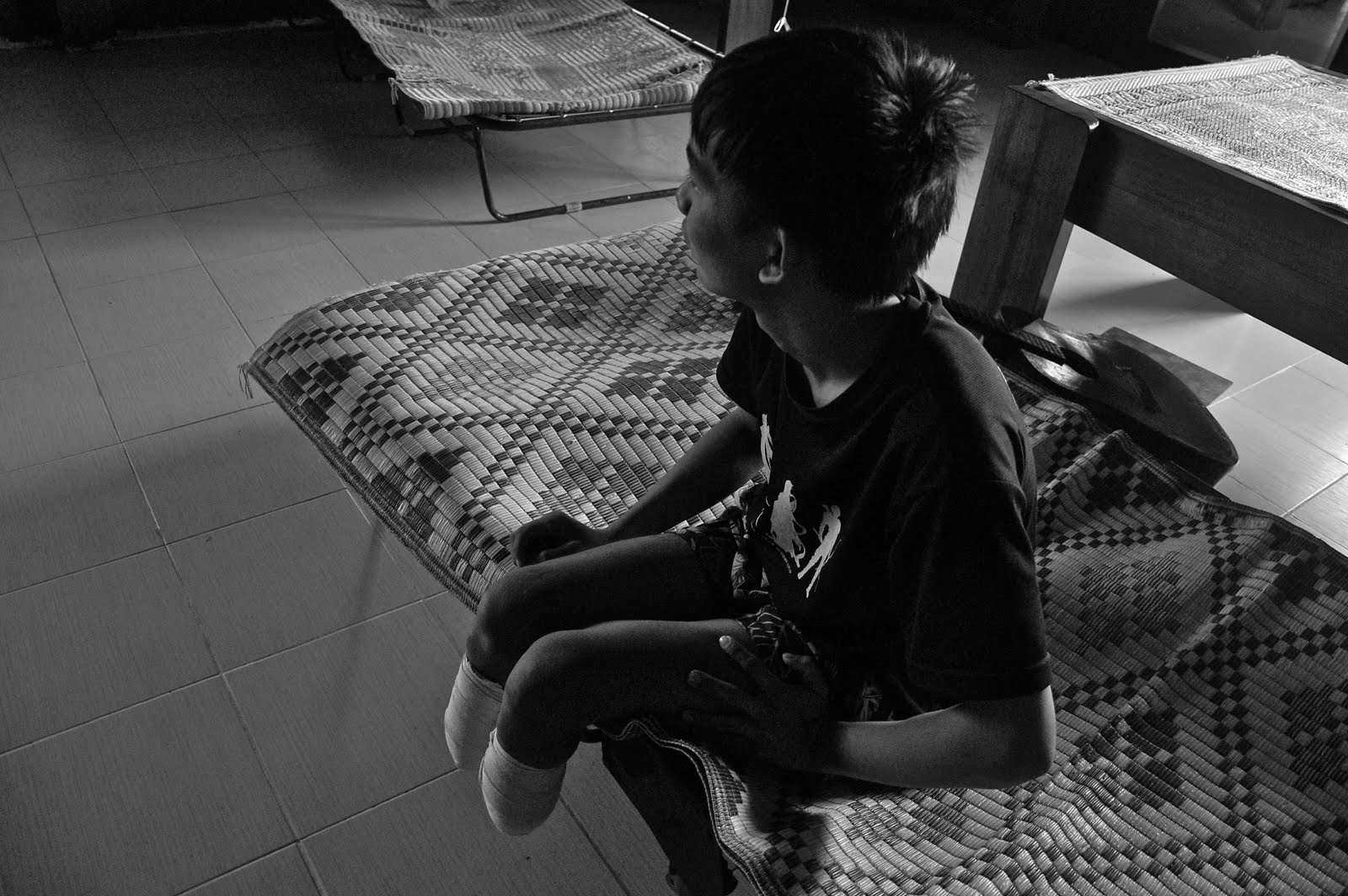
19 year old land mine victim

Burma/Myanmar is one of four countries (the others being Israel, Syria, & Libya) left in the world that still actively place land mines. The ICBL (International Campaign to Ban Landmines) reports that “landmines and explosive remnants of war caused 4,191 casualties in 2010, 5% more than in 2009... [though] the real figure could be nearer 6,000 casualties.” The total number of Burmese and Karen people becoming victims of these nefarious weapons of war are unknown. However, it is clear that dozens of seriously wounded individuals cross into Thailand each year to seek medical care at the Mae Tao Clinic on the border town of Mae Sot.
Karen refugee adjusts his dressing.

The Mae Tao Clinic provides free health care for Burmese refugees. Its multiple departments help administer treatment to land mine victims. Its services include intensive care, trauma, the main land mine ward, and a prosthetics department that creates artificial limbs to help victims reintegrate into society after healing.

I noticed a patient chart hanging in the prosthetics department, which showed that large majority of land mine survivors are men. It was explained to me by a clinic staff member that, due to the patriarchal societal structure in their tribal and rural communities, most women stay at home to cook, clean and care for the children, while the men go out into the fields to farm or into the forests for wood. These activities drastically increased their chances of being injured.
Land mine victim in the Intensive Care Unit.

Documenting the various land mine cases at the Mae Tao Clinic was a difficult story to work through: I was working with an incapacitating fever at the time, but there was also a palpable feeling of helplessness. It pained me to see that there was very little that I could do to ease their pain. All I could do was hold their hand, speak a few words in broken Karen or Burmese, and photograph their lives, stories, and suffering to share it with the world. The whole time I was at the clinic, I felt isolated and alone. I empathized deeply with the emotions expressed by the victims as they lay in bed: alone, without friends or family, unable to do anything to improve their situation.

However, while this unfortunate reality was true, I noticed one very remarkable act - the smallest act of compassion or awareness could dramatically alter the mental states of the patients. No, I could not fix the damages that have been done to each refugee, but in this time of personal crisis, I found a recognition from the victims: Someone (and a white American, at that) had left their comfort zone and traveled a very long distance to understand the experiences of a people that can be easily overlooked and forgotten. I could see that it had become clear to the patience that, in desperate moments, there are still people around the world who care about them. It noticeably reignited a sense of hope.

That, to me, is the purpose of activism. No one person will ever change the world - if you set out with that goal, you will surely fail. Gandhi and Dr. Martin Luther King would have been nothing without the thousands of ordinary people supporting them, who showed individuals acts of non-compliance. It is those everyday acts of compassion and resistance - holding a hand, words of comfort, showing compassion and caring- that will actually make a difference and invoke a positive change in our world.

We are never truly alone when connected to our common humanity.
Open wound.

Wednesday, November 30, 2011

The Mae Tao Clinic for Burmese Refugees

This report was written while I was living on the Thai/Burma border and I must admit, I’m not sure how to fully describe the painful experiences of the hundreds-of-thousands of Burmese refugees living in Thailand. Yet, I will do my best to show you through my photography the individual lives and experiences of a few refugees that I had the privilege of documenting while echoing the lives of thousands of Burmese people displaced by war.

The Mae Tao clinic is a free health care center on the outskirts of the border town of Mae Sot, Thailand which was established in February of 1989 by Dr. Cynthia Maung after fleeing violent repression from the Burmese government. Twenty-two years later, the Mae Tao clinic has vastly grown and now consists of several departments to address the needs of the ever-growing number of refugees crossing the border river every year. Upheld year round by some 630+ staff, the long list of these departments include: Dressing, Surgery, Trauma, Prostheses for land mind victims, Pre-natal/Post-abortion care (abortions are illegal in Burma but legal in Thailand), Food & Nutrition, Blood Transfusions, Water & Sanitation, Child Protective Services, Eye Care, Training Programs, HIV Care, School Programs, Dental, Social Outreach and Housing Accommodations for in/out patients as well as those traveling long distances to receive care. All of these vital services are free for the 150,000 refugees and illegal immigrants every year who otherwise cannot receive any health care whatsoever. The only payment required by the clinic is an initial registration fee of around 25¢!
Bedridden by injury.

Burma has the worst health record in Southeast Asia. The Mae Tao clinic report “From Rice Cooker to Autoclave” has published findings by Phil Thornton from the Bangkok Post which state that the “UN’s Development Programme's Human Development Index has ranked Burma # 130 out of 177 countries. The World Health Organization placed Burma’s health system as the world’s second worst out of 191 countries”. Per capita, “Burma’s official spending on health care is estimated to be $0.74 compared to Thailand, which invests $89”. Mr. Thornton continues to highlight how damaging the figures are on the ground by reporting that, “Over 7% of Burmese children don’t survive their first year on Earth and 10% will die before their fifth”. That's approximately one in fourteen gone before their first birthday, and one in ten that won’t see their fifth year of life.
Young girl in the trauma ward.

This neglect of human life and dignity is not from a lack of funds; rather, it highlights the depth of government corruption. The nation of Burma/Myanmar has a 1 -2 billion dollar a year revenue from oil and natural gas, and yet a John Hopkins School of Public Health report shows gut-wrenching evidence that the current regime spends “as little as 3% of national expenditures on health, while the military, with a standing army of over 400,000 troops, consumes 40%”.
A woman hospitalized by domestic violence.

This treatment center is crucial, as the situation in Burma/Myanmar is constantly fluctuating from instability to open war between the government and ethnic groups, such as the Democratic Karen Buddhist Army or the Karen National Liberation Army, fighting for autonomy. Of course, every time war and conflict erupts inside of Burma there is loss of life, increased hardships and hundreds of arrests, disappearances, internally displaced people and refugees. Dr. Cynthia Maung has stated that, “Over the past twenty years I have never seen the patient caseload decrease”. To give weight to Dr. Cynthia’s words the Mae Tao clinic treated 1,351 trauma cases in 1999, which skyrocketed to 7,074 caseloads in 2008. In 1990 the clinic delivered 6 babies and a whopping 2,433 babies in 2008. Taking the doctor's words as truth, we can be sure that these numbers are even higher now in 2011 and will have exponentially increased by the time the next report is published.
A mother watches over her new born daughter.

The Mae Tao clinic runs its programs on year by year funding and with the global financial crisis still hitting many regions around the world supporters are backing out of their commitments and cutting off their contributions, leaving the looming question: Will the clinic have the necessary funds to continue their expanding work next year or the year after? As of now, 40% - 50% of the funding comes from the US AID program but with America tightening its grip on foreign spending (but not military expenditures) cuts are being made to social programs across the board. After personally witnessing the clinic and glimpsing the lives of those that depend on its help, I can begin to fathom what would happen if the clinic becomes unable to accommodate these desperate and displaced families. What would they do? And honestly, what other options would they have?
Young monk.